
Media: Kritik.si
Authors: Marijan Zlobec
Date: Fri, 26 Aug 2022
Link: https://kritik.si/2022/08/26/slovenski-mladinski-orkester-z-druzino-krajncan-na-koncu-sprejet-z-ovacijami/
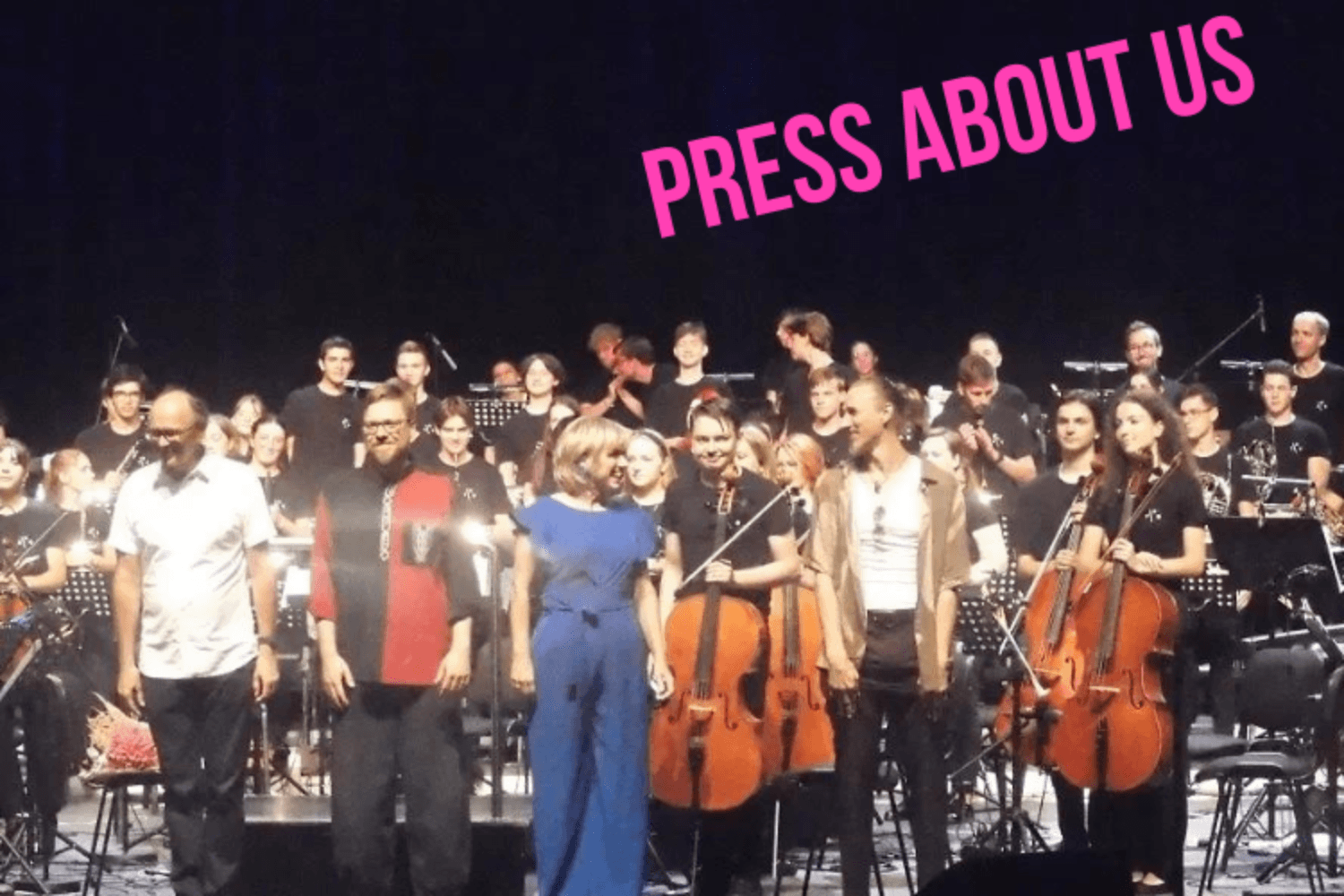
Concert of the Slovenian Youth Orchestra with members of the Krajnčan family last night at the Križanke Summer Theatre with conductor Živa Ploj Peršuh confirmed that it was the right decision to found such an orchestra of young people aged between 12 and 22, who, at various educational levels and in various forms, are preparing to embark on a professional music career, or a teaching one, or will go on to study something else. In any case, the path is the right one, a good one, and it has also proved very successful and well received as a concert venture, although the audience could have been even larger, as several mass concerts were taking place in Ljubljana at the same time as part of the Nights in Old Ljubljana festival, which began yesterday.
Živa Ploj Peršuh has, in shaping each of her programmes, set herself the task of presenting Slovenian musical culture in different ways, in all its diversity and with the interweaving of various musical genres, as she did last year with a musical programme featuring a selection of songs by the group Katalena arranged by Matija Krečič. This year she invited the musical Krajnčan family to collaborate, represented by composer, arranger and conductor Lojze Krajnčan, singer Romana Krajnčan, his wife, and their sons Kristijan Krajnčan, who appeared as a cellist and drummer, and Žigan Krajnčan, vocalist and dancer. Unfortunately, Živa Ploj Peršuh did not invite Lojze Krajnčan to conduct any of the pieces, so that we could have seen him live in his role as a conductor.
In this context, she shaped the concert programme with particular refinement and a richness or distinctiveness of content that could not be repeated, unless they themselves perform elsewhere, which would be both possible and pleasant.
In the biography of conductor Živa Ploj Peršuh I read, among other things, that many of her projects are aimed at raising the profile of Slovenia, as well as at bringing young people from all over the world together in Slovenia. She collaborates with world-renowned soloists and numerous foreign institutions as part of the project EU Music up close network: the Accademia Nazionale di Santa Cecilia in Rome, national orchestras from Lille, Amsterdam and Barcelona, the Belgrade and Sarajevo Philharmonic Orchestras, the Royal Concertgebouw Orchestra, the Ljubljana Festival and others. She is convinced that it is important to pass on artistic knowledge and skills to young people, especially in classical music of all periods and genres, which is why she gathers around her the most capable and most acclaimed musicians from Slovenia and from all over the world and brings them to Ljubljana.
Besides peers, the family environment also has a significant influence on personal development; a single quick look at the biographies of outstanding musicians, past and present, paints a clear picture: most of them were, in one way or another, in daily contact with music in their family environment. One such family, in which music pervades everyday life, is the aforementioned four-member family of artists with well-known names, who bear the surname Krajnčan.
Živa Ploj Peršuh opened her concert with a selection from Gustav Holst's suite The Planets, Op. 32. We heard a jazzier Jupiter, the Bringer of Jollity, and a calmer, almost mournful Saturn, the Bringer of Old Age. This contrast reminded us that the cycle of life is a long one, even if young musicians, in the immediacy of experience, are not aware of it. Already here the conductor showed a fine sense for programming, as her orchestra was also able to show itself to good advantage. It sounded well rehearsed and clean, though I would remark that throughout the evening it was audible that the instruments at the back were insufficiently amplified and sounded too modest.
The first member of the Krajnčan family to perform was the vocalist or singer Romana Krajnčan, with no fewer than four songs, with which she first highlighted the songwriting of Brina Štampe Žmavec ( Manjka mi, manjka ), Feri Lainšček ( Ljubezen ), Branko Rudolf ( Huda mravljica ) and again Feri Lainšček ( Bila sem srečna danes)
Romana Krajnčan is the star of many children's hearts and has been involved in music since a young age. She has worked with the ensembles Sibila, 12. nadstropje, Kranjski Dixiland Band and RŽ. In 1989 she recorded her first cassette for children, Romana in Bolhobend, which was followed by a further 12 cassettes and CDs, five musicals and music-and-dance productions. She has published the books Murenčki and Šola za klovne, as well as the songbook Poj z menoj for children's and youth choirs. For five years she was editor of the music pages in the magazine Ciciban, and for ten years she hosted her own children's programme Na vrtiljaku z Romano on Radio Kranj. She has worked with various acclaimed Slovenian poets (Tone Pavček, Andrej Rozman Roza, Feri Lainšček ), a host of excellent musicians and various choirs. She has also recorded three albums of her own chansons: Nekaj je v zraku (2004), Vonj po ljubezni (2008) and Manjka mi, manjka (2011). Her work has received numerous awards. (From the biography in the programme).
The singer is a true interpreter of songs, both vocally and emotionally, varying in line with the content of what is being sung; besides the old Huda mravljica, perhaps the most interesting was Lainšček's Bila sem srečna , which came across like a Gypsy chanson. In general, her singing combines various components or a fusion of genres, but without any single one dominating. Apart from Marjan Vodopivec's Huda mravljica, the music was written by Lojze Krajnčan, who also arranged the orchestral accompaniment.
Lojze Krajnčan's Tango was performed by the soloist, cellist Kristijan Krajnčan , who delivered a striking cadenza before the orchestra joined in with accentuated Latin rhythms, although it seemed that the tango melody itself was not especially pronounced or dance-like; it was, however, undulating, with certain crescendos and a singing quality. Here father as composer and son as soloist worked well together, accompanied of course by the orchestra.
Particularly special was the interpretation, or reworking, of the well-known White Carniolan folk song Zeleni Jurij, arranged by Lojze Krajnčan and featuring cellist Kristijan Krajnčan as soloist. He offered several new soloistic approaches, starting with a long solo passage, though not without the familiar melody emerging, at least passively or as a motif, while not staying very close to folklore.
After completing secondary music school (cello and percussion), Kristijan Krajnčan (1986) graduated in jazz drums from the Prince Claus Conservatoire in the Netherlands and earned a master's degree in film music from the conservatoire in Amsterdam. He has featured on 25 CDs and performed in more than 25 countries in Europe, USA, Asia, Indonesia, Africa and the Middle East. As a film composer, he has scored three feature films and nine short films. He has received numerous awards in all areas of his work, such as the first Jazzon award for the best Slovenian jazz composition (2006), first prize for best screenplay at the Arab Film Festival (Rotterdam, 2016), and first prize at Temsig (1997 and 2003). In 2012 Edict Records released his debut album Kristijan Krajnčan Ensemble: Siberian Bear. He is the founder, director, drummer and composer of the interdisciplinary project Hidden Myth, premiered at the Jazz Festival Ljubljana (2015), in which several international artists combine music, dance,
In Kristijan Krajnčan's Requiem, arranged by his father Lojze Krajnčan, the composer himself again performed in his own distinctive style. The piece has a long solo cello introduction, so that at first it seems as if the orchestra will not play this time, but it does eventually come in, as the soloist takes on the role of one voicing grief, with a weeping vocal line like a shepherd's flute, and overall like a Balkan lament (in view of the former war with its enormous loss of life). As the piece continues, there are further exchanges between the solo cello and the orchestra, with the timpani also offering some dialogue.
Žigan Krajnčan (1995) is a dancer, performer and singer. He began his creative journey very early, playing the violin and trombone already at primary school, singing in a choir and being active as an actor and dancer. His movement language is a fusion of dance techniques such as popping, hip hop, ballet, release, Cunningham, krump, house, contact improvisation, moshing/slam dancing and yoga, which he constantly refines and develops while searching for new possibilities. He has worked with many choreographers and other artists, such as Matija Ferlin, Maja Delak and Gregor Luštek. Together with his brother Kristijan Krajnčan he co-created the aforementioned project Hidden Myth. He has directed several productions, choreographed more than ten theatre, contemporary and urban dance works, worked as a dancer/mover in several international productions and taught hip hop, popping and contact communication. In recent years he has devoted himself to an exciting interweaving of dance, singing and beatboxing. He choreographs his own performances, and also writes and directs his own songs. He encourages his target audience to be creative and to explore, and above all wishes to encourage parents to understand and support their children in their desire to create. (From Aleksandra Gartnar Kastelic's programme notes).
Žigan Krajnčan offered a very special, one might even say unique, danced and sung interpretation of one movement – Allegro – from Bach's Brandenburg Concerto No. 3 in G major, BWV 1048. Decades ago we came to know Bach through the jazz vocal interpretations of Les Swingle Singers, and at the time it seemed that Bach could essentially also be a contemporary dance author or composer. Žigan proved this and, what is more, introduced or demonstrated his own distinctive vocal technique, so that his performance was something entirely unique in its expression, voice and movement, and therefore thrilling.
But that was only the beginning, as he continued his performance with his own piece Oma Desala , arranged by Lojze Krajnčan, in which Žigan excelled with singing as a kind of vocal exoticism that is not based on any song structures, but on vowels, syllables and the odd unrecognisable word, until we arrive at a kind of quasi-sentences without content. In this sense, the orchestral accompaniment was also special.
In Sunlight reggae, also by Žigan Krajnčan and arranged by Lojze Krajnčan, the vocalist was joined among the percussionists by his brother Kristijan Krajnčan. As could be heard or seen from afar, he played the conga drums. Žigan sang again, but there seemed to be more articulation of text, albeit in an artificial language, though it remains an open question whether it is a language at all.
The final piece of the concert was Danzón No. 2 by the contemporary Mexican composer Arturo Márquez Navarro (1950). The work is written in several sections, with Latin American rhythms and melody coming to the fore, and with quite a few solo passages, such as trumpet, oboe and flute, as well as trombones and tuba; the saxophones were less audible, and the piano and both harps barely…
It is a pity that the conductor did not check the sound from the auditorium before the concert, or rather, even before that, the supposed sound experts should have heard it, though time and again it turns out that we do not have any.
The conductor prepared the programme in exemplary fashion, the orchestra made every effort to play cleanly, but the biggest surprise came from the two brothers, who made full use of the opportunity for wider recognition, including within the programme of the 70th Ljubljana Festival. I rather missed an encore in which the present-yet-absent Lojze Krajnčan might have stepped up to the podium to play or conduct something from his extensive repertoire. Here she seemed to me Živa Ploj Peršuh slightly egotistical.
The audience, which did not fill the Križanke Summer Theatre as it had for the new musical Povodni mož or, before that, for the film music concert, repeatedly accompanied the performers with rhythmic applause, and at the end with ovations.


