
Media: Kritik.si
Authors: Marijan Zlobec
Date: Fri, 23 Aug 2024
Link: KRITIK.si
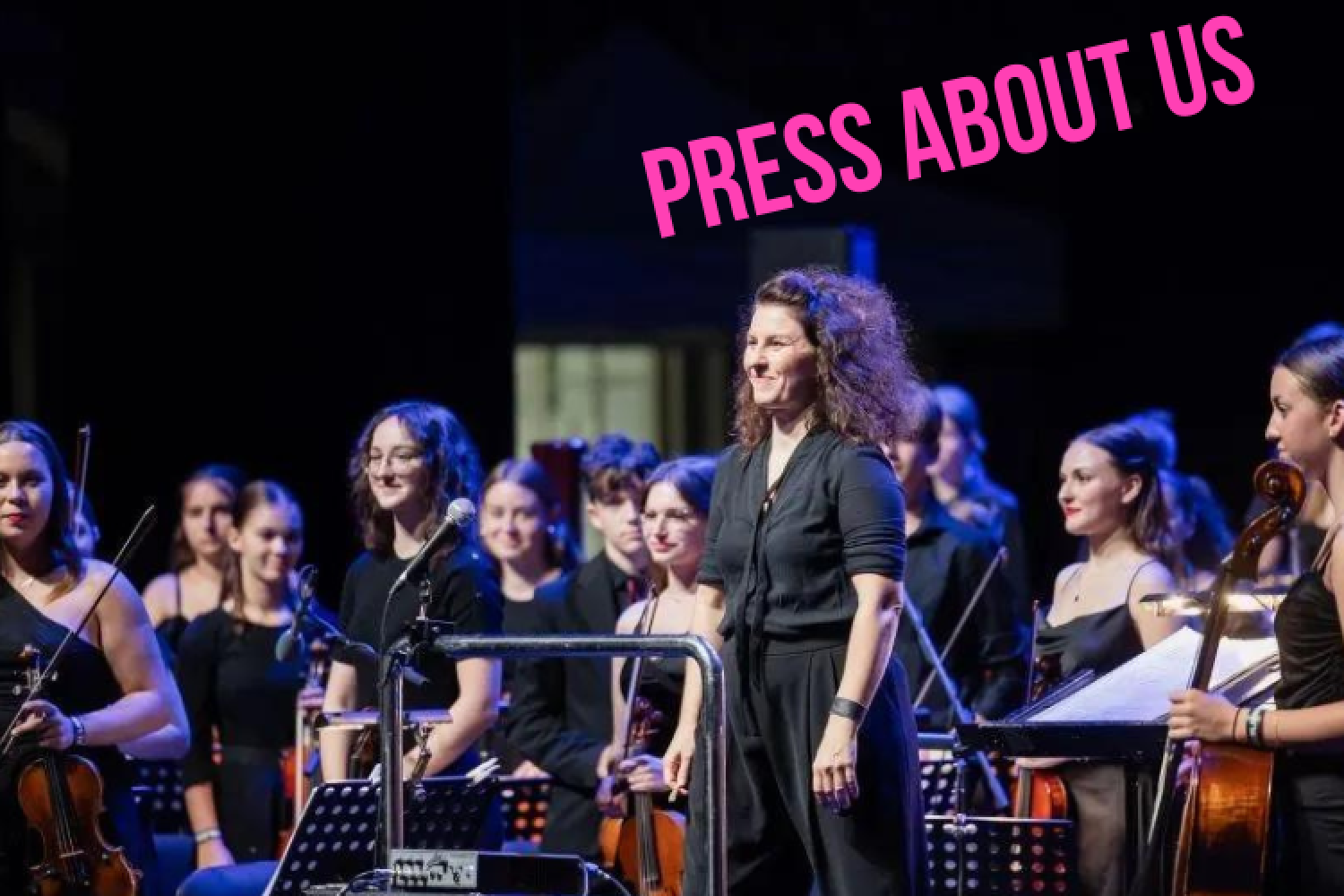
The Slovenian Youth Orchestra performed to a full Križanke Summer Theatre at the 72nd Ljubljana Festival. It was founded and is artistically directed by the conductor Živa Ploj Peršuh. Her organisational and unifying strength and her personal magnetism in relation to young musicians from all corners of Slovenia – who are, after all, of quite different ages and levels of musical and concert experience, which of course shows on stage and can be heard in the auditorium – guarantee the orchestra’s work, with the support of the Ljubljana Festival and the inclusion of the concert in the annual festival programme.
All festivals support young musicians, regardless of the later individual fate of each one of them. They usually support senior academy students or graduates. A decision someone makes at the age of thirteen is probably not the same as their entry into secondary school, their school-leaving exams there and the academy, since even graduates often cannot find work and do not know where to turn.
Musical education and work in this orchestra must nevertheless be based on professionalism, as if they were all to become lifelong professional musicians. What is needed is motivation, encouragement, role models, joy and also a simple love of classical music.
At Monday’s concert dedicated to Frank Zappa, we saw his saying written out: Music is the only religion that delivers the goods. These, however, depend on both one’s outlook on life and one’s artistic outlook. If young musicians are given strong role models and examples, the path ahead will be much easier for them.
The annual concert and a full audience are a wonderful encouragement. At the concert we heard a very varied programme.
The American composer, pianist and conductor Scott Bradley (1891–1977) is known for his music for Metro-Goldwyn-Mayer (MGM) cartoons, above all for the cat and mouse Tom and Jerry (Hanna-Barbera, 1940–1958). He was an academically trained composer and pianist who, after MGM founded its cartoon studio in 1937, worked for it until its closure in 1957. By the end of the 1940s his style had become original and complex; he used the twelve-tone technique after Arnold Schoenberg and composed under the influence of Bartók, Stravinsky and Hindemith. (From the programme notes by Metka Sulič.)
Straight away we heard a technically demanding composition illustrating all kinds of changes, above all of movement, of the well-known characters from these cartoons, adorned or defined by special mini-stories, scenes, lightning accelerations, retreats, hesitations, second thoughts, working out the best situation… The cat and mouse are unpredictable in their relationship, and so is the music. Peter Tovornik is listed in the programme as its arranger.
The Nutcracker is a fairy-tale ballet written and orchestrated by Pyotr Ilyich Tchaikovsky (1840–1893). One of the most popular ballets of all time, it is usually performed over the Christmas and New Year season. Waltz of the Flowers is from the second act and concludes the Divertissement, which is a kind of exotic journey around the world and through different cultures. It is a popular piece in the film industry, and several films have also been made based on the ballet. (From the programme.)
One would hardly agree that this is film music of any kind, so a selection of well-known scenes in itself would have made a more pleasing picture and a more complete musical impression.
Pietro Mascagni (1863–1945) won first prize for the one-act verismo opera Cavalleria rusticana (Rustic Chivalry) . This passionate tragedy of reckless infatuation, betrayal and revenge takes place in a small Sicilian village at Easter. The pastoral scenes give the opera a special charm. The heart-rending Intermezzo is the best-known excerpt from the opera and appears in the final scenes of The Godfather film trilogy, when the beloved daughter of a notorious mafioso is accidentally killed in a crossfire on the steps of the opera house. (From the programme.)
The Intermezzo is not film music either, but Cavalleria rusticana as an opera is used in a large part of The Godfather Part III, since it is set at the opera, where on stage we hear a soloist and chorus with particular symbolic meanings, from Christ to blasphemy.
I would have expected greater depth of feeling in the performance; on the other hand, young people find it harder to sense what is essentially the psychoanalytical function of the music and its foreshadowing of a hero’s tragic end, as in the opera, whereas in the film it is a shooting with a fatal outcome for a young woman, a daughter.
Everyone loves to perform the Intermezzo, but only a few do so with depth and a sense of tragedy. It depends on the conductor.
Lauri Porra (b. 1977) wrote the piece entitled Entropia in 2015. The composer gave its premiere with the Lahti Symphony Orchestra at the season opening marking the 150th anniversary of Jean Sibelius. The concerto for electric bass and orchestra, lasting almost 28 minutes, consists of four movements. In it he combines styles ranging from rock and jazz to classical, electronic and film music. He fuses the sound of the electric bass with that of the orchestra; he complements the sound spectrum of the rock instrument with the orchestral one, blending the two into a balanced whole. (From the programme.)
Including this Finnish composer was presumably meant to liven up the concert evening, when a well-known or lesser-known guest is expected. This raises the question of whether this music is close to young musicians and whether they grasp and accept it quickly, since it requires broader study and preparation, in which the composer and soloist himself can admittedly take part; yet the whole did not seem to be an essential condition for the concert. I would rather think that this item was oversized, especially as it is not film music and departed entirely from the programme concept of the concert. I do not know what lies behind it.
Jani Golob (b. 1948), Slovenian composer, arranger, violinist and teacher, is the author of many chamber and orchestral works as well as music for film, various advertisements, television announcements, etc. He studied violin and composition at the Academy of Music in Ljubljana. His output lies on the borderline between serious, light and jazz music. Among his best-known film scores are two unforgettable films for young audiences, both set in summer: the romantic Poletje v školjki (1985) and the adventure film Čisto pravi gusar (1987). (From the programme.)
Jani Golob is distinctive enough and appealing in his own way, but Poletje v školjki needs vocals, indeed requires them, otherwise the performance remains a torso. It would have done no harm – or rather, it would have been better and more authentic – if a few young singers, the age of the film’s characters, had come on stage. In the opening piece Leave us this world a small choir too. In selecting film music, however, there is sometimes the question of copyright (and how to resolve it), as there would otherwise be plenty of composers to choose from.
The best-known work by the American composer, conductor and pianist Leonard Bernstein (1918–1990) is the musical West Side Story. The concept follows the plot of Shakespeare’s tragedy Romeo and Juliet. Bernstein sets the story in New York among gangs (immigrants and white Americans); it is full of passion, jealousy and revenge. Mambo is a dance excerpt, fast and energetic, in which the protagonists dance in a show-what-you-can-do spirit. It is inspired by Cuban rhythms. In 1961 the musical was made into a film that won ten Oscars. (From the programme.)
Mambo is a test of the ability to make music together with virtuosity, which must be based on perfection in every sense; there was not as much of this as when we heard Mambo performed, for example, by the Sinfonica Alicante orchestra, or as when we watch the performance by the Simon Bolivar Youth Orchestra – Orquesta Sinfónica Simón Bolívar de Venezuela under the baton of Gustavo Dudamel. SMO still has a long way to go to reach that level. Here I missed a clearer layout on stage for the orchestra of as many as 106 members, with greater verticality and visibility of the woodwind; we saw only 9 flutes, horns, clarinets, saxophones and bassoons, and no oboes at all. It was better with the trumpets and trombones, though the tuba was already too far to the side. The audience has the right to see all the musicians.
The Italian composer Nino Rota (1911–1979) wrote a great deal of music for film. He worked with Federico Fellini, Luchino Visconti, Franco Zeffirelli and Francis Ford Coppola. For the latter he wrote the music for The Godfather (Part I in 1972, Part II in 1974). The trilogy about the Corleone family, an influential mafia clan in the USA, is regarded as one of the most important in the film industry, and his music is an integral part of that success. Rota’s music subtly captures the essence of the themes, characters and emotions, creating a distinctly Italian atmosphere set within the American mafia milieu. The main theme, The Godfather – Waltz is a mysterious, somewhat ominous melody; the second best-known is the Love Theme. (From the programme.)
It is the more beautiful Love Theme, because in The Godfather, despite all the mafia themes, love is expressed in many stories and, of course, fates, most often in the most tragic way – through death. Through many deaths. Here the orchestra was receptive and embraced the distinctive melody as its own. Well, this was already the second piece of music from The Godfather. The music was arranged by Marjan Peternel.
Montevideo, Bog te je videl! is a 2010 film inspired by the true events that led to the Yugoslav national football team taking part in the first FIFA World Cup in Montevideo (Uruguay) in July 1930. The witty yet moving sports film was directed by Dragan Bjelogrlić. The music was by Magnifico, Robert Pešut. Pukni zoro is a slow, nostalgic song. An excellent creator of music who blends influences from all ethnic and cultural winds in an original way, he wrote this song as if it were authentic folk music with roots somewhere in the heart of the former common state. (From the programme.)
Magnifico is essentially a Balkan musician, in mentality and personality, in feeling, melody, rhythm and musical knowledge in general, which is more instinctive than studied. But you know how it is with schooling. In Slovenia we have 5,000 doctors of science, but if you did a street survey, I do not know how many of them people would remember. Magnifico has successfully integrated into our scene. Unfortunately, he did not come to the concert for the young people to see him. The music was arranged by Matija Krečič.
Marjan Kozina (1907–1966) was one of the first Slovenian composers to write film music. In 1948 he wrote the music for the first Slovenian post-war film Na svoji zemlji. In 1951 he created the music for the first Slovenian children’s film Kekec, directed by Jože Gale after the story by Josip Vandot. Kekec’s song and the Mojca’s song were adopted by Slovenian children as their own. In this music Kozina showed a great feeling for the world of children. (From the programme.)
The inclusion of Kekec’s and Mojca’s songs likewise evoked nostalgia for times gone by, as did the whole film programme, or rather the music from films that younger generations are watching anew, while we older ones remember what it was like back in the days of black-and-white film. I myself would, of course, have put singers on stage as both Kekec and Mojca, at the ages of their film characters. Kozina’s music was first arranged by Marjan Vodopivec, and for this concert by Nejc Bečan.
Marcel Štefančič jr. hosted the concert with his comments and explanations of the films from the point of view of their music, history, making, particular content, the context of collaboration and, not least, their impact. Some comparisons were slightly or even quite metaphorical, self-satisfied and, of course, provocative, which means you do not necessarily have to believe them, as the famous Italian saying goes, “se non è vero, è ben trovato” “or “even if it is not true, it sounds good”.
After long and stormy applause, there were no fewer than two encores, repeats of the Bernstein and the Kozina.
The concert made a great impression and was very successful, but in future it will be essential to sharpen the criteria for performing in the Slovenian Youth Orchestra, with rigorous demands for knowledge and the ability to make music together. There will, however, be 20 fewer musicians on stage. Unfortunately, perfection does not improve over the years.


