
- Media: Kritik.si
Authors: Marijan Zlobec - Datum: Pet, 25. aug. 2023
Povezava: https://kritik.si/2023/08/25/ute-lemper-navdahnila-mlade-slovenske-glasbenike-z-zivo-ploj-persuh/
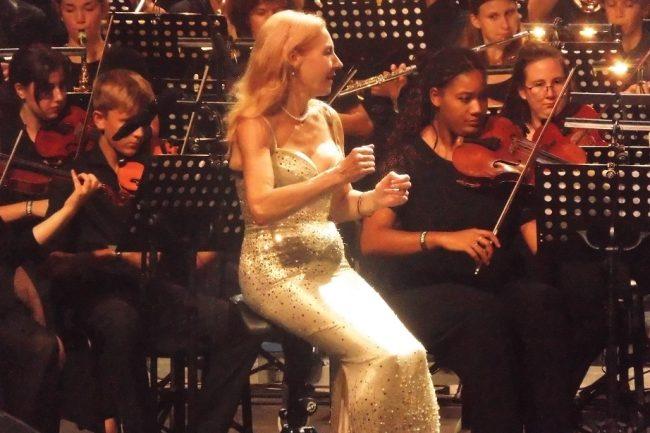
Letošnji tradicionalni koncert of the Slovenian Youth Orchestra pod dirigentskim vodstvom svoje ustanoviteljice in umetniške voditeljice Živa Ploj Peršuh je na 71. Ljubljana Festivalu napolnil Poletno gledališče Križanke. Orkestru se je pridružila kot gostja slavna nemška pevka Ute Lemper, v avditoriju pa smo opazili mnoge znane obraze iz sveta glasbe in gledališča.
Koncert v Križankah, vse fotografije Marijan Zlobec.
Prav je, da se mladi generaciji glasbenikov, ki prihajajo in so člani omenjenega nestalnega orkestra med starostjo deset in šestindvajset let, nameni posebna pozornost ter javni odmev. Sodelovanje mladih s tako znano glasbenico pa je zlasti njeno posebno priznanje, ki pa je povezano z njenimi materinskimi izkušnjami in vzgojo ter nasploh bogatim ter vsestranskim mednarodnim umetniškim življenjem. Nekaj je o tem spregovorila z odra, ko je hvalila Ljubljano in se organizatorjem ter mlademu orkestru zahvalila za povabilo in sodelovanje, nekaj pa kasneje na krajšem sprejemu na Peklenskem dvorišču.
Živa Ploj Peršuh
Na kratko smo jo že predstavili, a naj bo še enkrat. Kariera Ute Lemper je obsežna in raznolika. Kritika in poslušalstvo jo ceni kot pevko berlinskega kabareta, francoskega šansona, v muzikalih na Broadwayu, v Parizu in londonskem West Endu. Rodila se je v Münstru v Nemčiji, študij pa je opravila na Akademiji za ples v Kölnu in na Seminarju.
Maxa Reinhardta na Univerzi za glasbo in upodabljajoče umetnosti na Dunaju. Debitirala je v dunajski produkciji predstave Mačke. Vloga Sally Bowles v Kabaretu Jeroma Savaryja (Pariz) ji je prinesla nagrado Molière za najboljšo igralko v muzikalu. Za vlogo Velme Kelly v Chicagu na West Endu je prejela nagrado Laurence Olivier, leto zatem pa še nagrado.
American Theatre. Ute Lemper solo koncerte z deli Weilla in Brechta, Dietrich in Piaf, Jacquesa Brela, Lea Ferréja, in Sondheima ter berlinske kabaretne večere izvaja v prestižnih dvoranah po vsem svetu.
Ute Lemper
With symphony orchestras from London, Israel, Boston, Hollywood, San Francisco and Berlin, the Paris Radio orchestra, Illusions and the Michael Nyman Band, she has performed works such as The Seven Deadly Sins, songs by Kurt Weill and Songbook. Her discography is very extensive. Decca has released 10 CDs featuring works by Weill, Nyman, Dietrich, Piaf, Prévert, Sondheim, Brel, Piazzolla, Heymann, Eisler, Berlin cabaret songs and her own works. In 2000, Decca/Universal Music released the album Punishing Kiss with new songs written for her by Costello, Waits, Glass and Nick Cave. On the CBS Records and Polydor labels she released a further six albums. She has appeared in many films, including Prêt-à-Porter (Robert Altman), and in numerous television programmes for Arte, HBO. She lives in New York with her four children, Max, Stella, Julian and Jonas.
Če bi rekel, da je bil ves večer v znamenju gostje Ute Lemper, bi to bilo krivično do orkestra, ki je uvodoma predstavil zalo zahtevne Tri plesne epizode iz muzikala On the Town za orkester Leonarda Bernsteina. (Slavni glasbenik je v Ljubljani gostoval le enkrat na začetku obratovanbja Gallusove dvorane Cankarjevega doma in se ga mladi glasbeniki ne morejo spomniti). Muzikal On the Town je eden najbolj živahnih broadwayskih muzikalov, ki je v času druge svetovne vojne prekipeval od mladostniškega žara in optimizma. Bernstein ga je napisal leta 1944. Čar te igre je v lahkotnosti, s katero gleda na življenje, ki ga noče jemati preveč resno, a hkrati prikliče v zavest nevarnost vojne, v katero se bodo mornarji, ki se v 24 urnem postanku v New Yorku zabavajo z dekleti, nenazadnje morali vrniti. (Iz programa).
The opening already showed the orchestra to be very well prepared, but the one-sided and poor amplification was disturbing, especially of the strings, so that we practically could not hear the cellos and double basses, or indeed the violas, particularly in passages where there was an abundance or an above-average number of brass instruments on stage (trumpets, trombones). A sound engineer must notice this immediately, adjust the dynamics by every means available and make the performance cohesive and sonically appealing. Unfortunately, he did not hear this right up to the end of the concert or the orchestra's own encore. In general, it seems as though the performers do not realise that performing on stage is one thing, and audibility in an open-air summer theatre quite another. The conductor herself should have checked how her orchestra sounded by going to the top or the middle of the venue, as she would quickly have noticed that the beauty of the string sound was diminished, or rather that its softness and beauty were destroyed by or because of the loud background (10 trumpets, 5 trombones, massed woodwind including saxophones).
Ute Lemper began her performance with the famous song Milord, as it was once inimitably sung by Edit Piaf, whom no subsequent or later interpretation can join or surpass; it is like an unsurpassable stylistic and personal intervention in history that cannot be retroactively changed. Lemper immediately wanted to prove that she knows how and is able to do it, but it quickly became apparent that her French is more German (ž n še pa – can you work out what that is in French?). Her performance still seemed to be something of a warm-up.
Then she very quickly rose to true concert form and bearing, with Cabaret by the American composer John Kander and lyricist Fred Ebb, who created the work in 1966 for Broadway.
V štiridesetih letih sta glasbeno opremila štirinajst filmov in televizijskih oddaj. Kabaret je doživel 1165 ponovitev in leta 1967 prejel tonyja za najboljši muzikal ter sedem drugih nagrad, Kander in Ebb sta zaslovela po vsem svetu. Filmska priredba iz leta 1972 z Lizo Minnelli je osvojila več oskarjev. Druga uspešnica, Chicago, je doživela več kot 900 ponovitev in bila nominirana za enajst tonyjev. Muzikal je prišel tudi na filmska platna in leta 2002 prejel oskarja za najboljši film. (Iz programa).
This cabaret music opening was then linked with the Weimar Suite by Kurt Weill and the writer Bertolt Brecht. As a Jew, Weill was persona non grata in Germany and left the country. With Brecht, Weill created two of his most important works: The Threepenny Opera and the opera Rise and Fall of the City of Mahagonny. Both are still in the repertoire of opera houses today.
Before both performances, Ute Lemper spoke about the cultural flowering of Berlin and Germany in the 1920s at every level: in music, theatre, ballet and dance, the visual arts, film, photography, essay writing, literature, journalism, fashion and design – in short, in every kind of programme that gave Germany an unimagined, yet genuinely achieved, creative freedom. That is why the experience of the change of power in 1933 was so harsh and, as quickly became apparent, so very cruel.
Rarer is the remembrance of the famous representative – or rather one labelled as German Entartete Musik – the Silesian-born Austrian composer Viktor Ulmann, whom she described explicitly from the stage, especially his tragic fate from Theresienstadt to Auschwitz-Birkenau, where in 1944 his highly creative life as a composer came to an end.
Pianist Vana Gierig
Here, in the final items of the programme mentioned, we sensed at the concert her greatest emotional involvement – not only musical, but deeply feminine and human. She mentioned the problem of sexual emancipation and the rise of women to an equal position – she saw a Slovenian conductor beside her – and she mentioned the German-American actress and singer Marlene Dietrich, who came from the Berlin district of Schöneberg, and of course her best-known song, Lili Marleen, which soon became a hit with both German and American soldiers.
Understandably, in the context of this biographical and historical involvement, it was precisely here that Ute Lemper reached the peak of her concert at Križanke.
The second half of the concert was more French, but also American and Argentinian. First we heard three songs, or rather chansons, by Jacques Brel: Je ne sais pas, Ne me quitte pas and Amsterdam. Here she recalled her first performance in Paris back in 1987 and warned us not to calculate how old she is now.
The master of chanson Jacques Brel was born in Brussels in 1929. Already in his school years he wrote short stories, poems, essays and plays, which he adapted for youth theatre. At 18 he joined his father in the family business. Alongside this he wrote songs and performed them in Brussels cabarets. He signed his first contract with Philips Records in 1953 and soon received an invitation to Paris. When he became famous, his wife and children left him. Later, while filming in the Caribbean, he met the young actress and dancer Madly Bamy, with whom he sailed around the world in a yacht for the rest of his life. His work influenced many musicians, such as Bob Dylan, Leonard Cohen and David Bowie. Among his best-known chansons is Ne me quitte pas (Don't leave me). (From the programme).
Quite a surprise were the next songs, Bob Dylan's Blowin in the Wind and Astor Piazzolla's Yo Soy María (de Buenos Aires). This personal confession comes from the opera María de Buenos Aires, which he wrote with the librettist Horacio Ferrer in 1968. It is an aria in which María introduces herself, a lady of the streets of Buenos Aires who loves, sings and seduces men with the tango. In Spanish she was again weaker (đo šoj).
With Bob Dylan, the confessional, lyrical side seemed particularly worthy of attention:
Odgovor je pihanje v vetru.
It is, however, stylistically different as a song, and here Ute Lemper again showed a new vocal and, one might add, acting display or personal confession.
What the World Needs Now Is Love by Burt Bacharach, winner of several Oscars and numerous Grammys, is a 1965 song with lyrics by Hal David, first recorded and popularised by Jackie DeShannon. On its release it became a big hit, which surprised its authors, as they were well aware of what Americans thought about the Vietnam War, which had prompted the lyrics. In 2023, DeShannon's version of the song was USA selected by the Library of Congress in the USA for preservation in the National Recording Registry. (From the programme).
To close her performance, Ute Lemper chose Avec le temps by Léo Ferré and All That Jazz by the composer John Kander and lyricist Fred Ebb.
Also named as guests of the orchestra and the concert were the pianist Vana Gierig and the double bassist Giuseppe Bassi. They had separate amplification and could be heard clearly, as could the jazz drummer and guitarist, again placed separately on stage.
The accompaniment was very solid, but again with the reservation that the strings could not be heard enough.
As an encore, Ute Lemper chose George Gershwin's song The Man I Love.
Stoječe ovacije
The concert was certainly more full-blooded than the film music concerts of the previous week. For the young musicians, the encounter with Ute Lemper will remain a lasting memory, as she thanked them in front of everyone on stage for accompanying her performance so beautifully.
At the concert we heard, among other things, the lines: “If I were too happy, I would long for sadness!” I do not believe it. We do not need sadness, least of all our own.
Marijan Zlobec


